


Designing a cybersecurity strategy for your physical security systems
Discover the ins and outs of building a resilient cybersecurity strategy for physical security systems, from everyday risks through to vendor assessment.

Most organizations wouldn't leave a door unlocked overnight. Yet an unpatched camera, controller, or connected security device can leave another way in. As physical security systems become more connected, every device on the network needs to be part of the cybersecurity strategy.
Our State of Physical Security 2026 report found that physical security and IT teams don’t always give cybersecurity the same priority. Here’s how organizations can close that gap.
TOOLKIT
Which cyber risks affect physical security systems?
It’s no secret that physical security systems make attractive targets. You already know your system holds sensitive video, access logs, credential records, and visitor details. You know encryption, access control, and robust authentication protocols are important to safeguard that data.
But do you know how often physical security cyber risks start with people, not systems? Our State of Physical Security 2026 report found that phishing and smishing attacks led the list of rising threats in 2025, ahead of malware, device hacking for network access, and social engineering. Credential theft and ransomware showed up too, both of which impact physical security. That's because a stolen credential can open a real door, not just a login screen.
Using human error to compromise a camera or controller gives an attacker a way onto your network. Once inside, they can reach whatever else that device connects to.
Knowing where these risks lie is only the first step. The next is figuring out how prepared your organization is to handle them. That’s what the maturity model below can help you see.
BLOG
How mature is your cybersecurity strategy?
Most organizations have the basics in place. The difference is whether they treat cybersecurity as a recurring operational process or a series of point-in-time activities when problems come up.
The five levels below describe how a mature cybersecurity framework typically develops, from reactive fixes to an optimized approach. Leveling up isn't just about doing more. It's about the strategic choices you make once you've covered the basics.
Where does your cybersecurity strategy sit today?
Level 1
Reactive – You fix issues after they surface
You’re here if: Updates happen when something prompts them
Next step: Inventory your connected devices and their users
Level 2
Managed – Your basics are documented and consistent
You’re here if: Staff are trained, and permissions follow roles
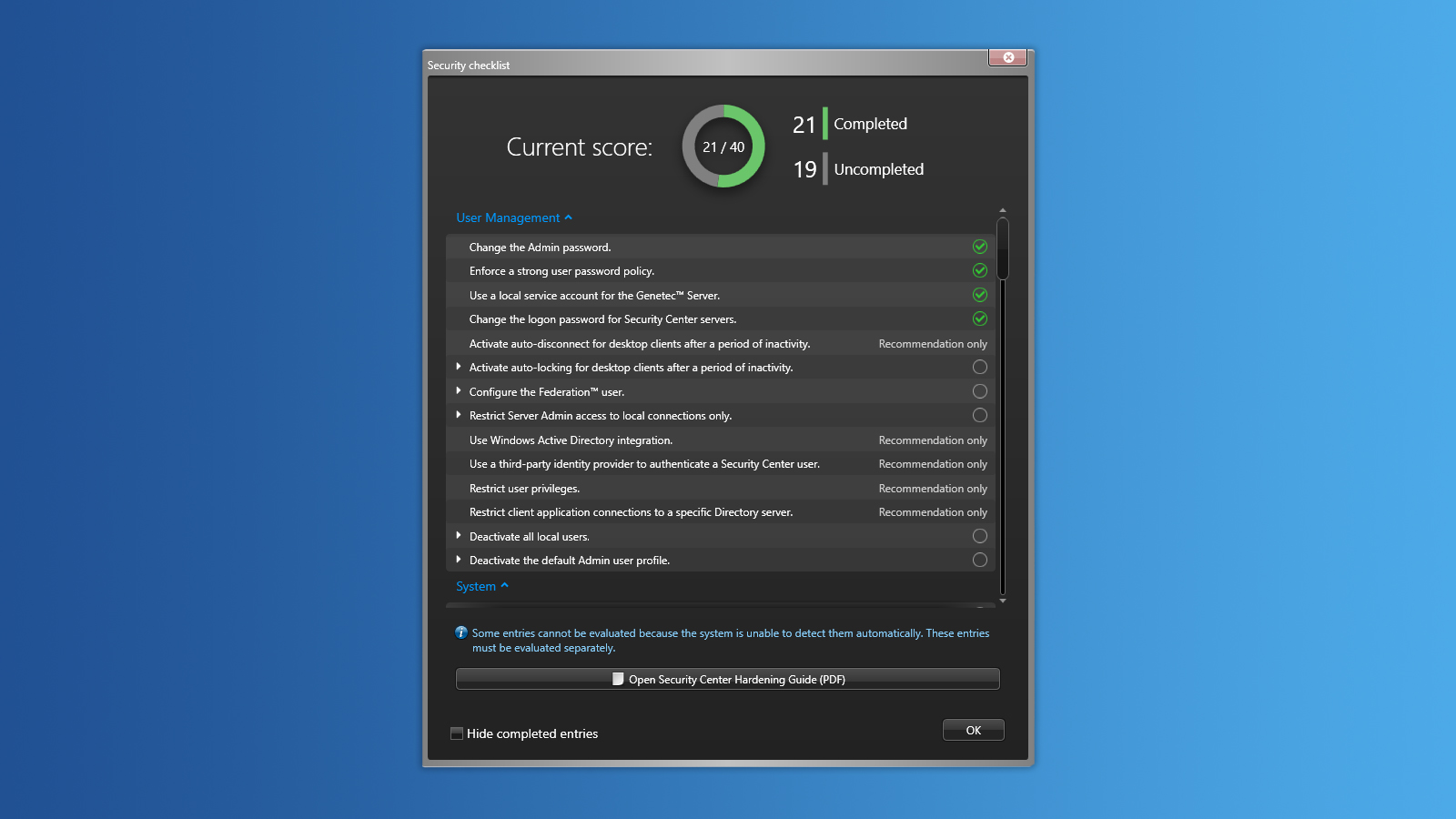
Next step: Apply your vendor's hardening guidance
Level 3
Proactive – You harden systems before incidents occur
You’re here if: Permissions are reviewed on a set schedule
Next step: Test your incident response plan
Level 4
Resilient – You limit impact and recover quickly
You’re here if: Backups are stored separately and recovery steps documented
Next step: Bring IT into your cybersecurity planning
Level 5
Optimized – You measure, improve, and share ownership with IT
You’re here if: Cybersecurity data informs operational decisions
Next step: Reassess as your systems and threats change
Advancing from reactive security to cyber resilience requires more than new tools. It takes smart operational choices.
The following three sections will help you work out where that effort is best spent: your deployment model, your certifications, and how carefully you vet the vendors behind your systems.
Deployment comes first. Whether you opt for cloud, hybrid-cloud, or on-premises, your choice decides how much of the cybersecurity load lands on your team versus someone else's.
How do cloud and hybrid-cloud solutions strengthen cyber resilience?
It might be tempting to assume that one deployment type delivers greater resilience than the others. But if that were the case, you'd expect organizations to be converging on a clear winner. Instead, our research into enterprise physical security found that organizations are not moving toward a single cloud model. Larger organizations are, if anything, more likely than smaller ones to operate mixed environments.
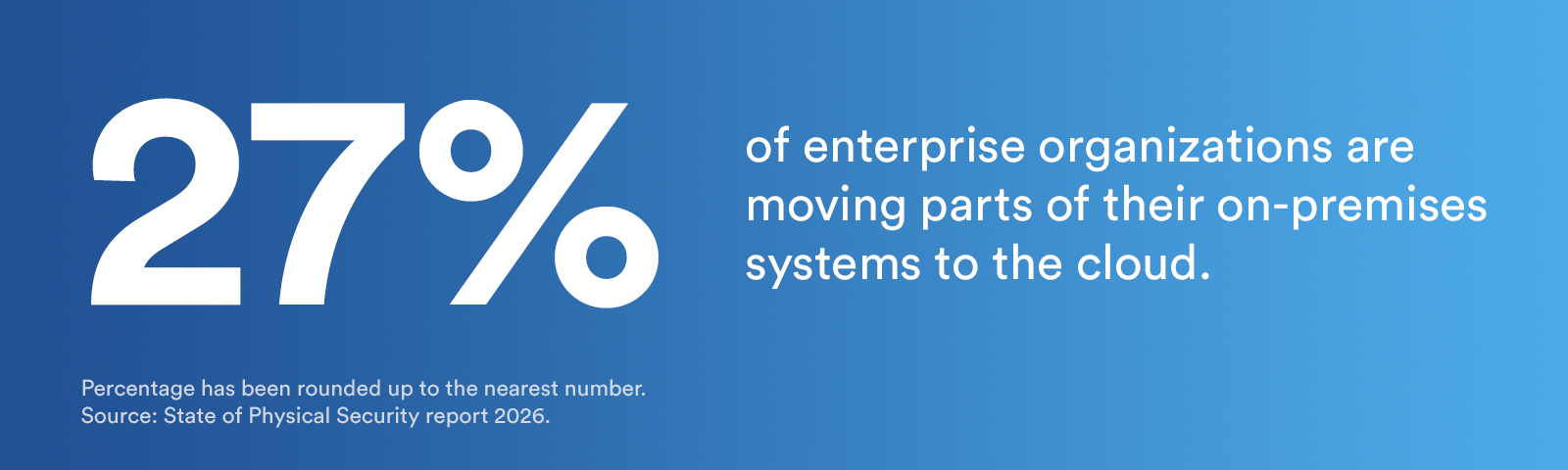
Combining cloud and on-prem solutions in a hybrid deployment can strengthen cyber resilience by letting you manage every camera, badge reader, and controller from one place, no matter how many sites you operate. This kind of central control affects how fast you can see, contain, and recover from an incident. That speed is also what moves an organization from “managed” to “resilient” on the maturity scale.
Basically, the deployment model matters less than maintaining consistent visibility, control, and recovery processes across every site. What determines resilience is whether you can see and control every site the same way, no matter if your sites run on cloud, hybrid-cloud, or on-premises systems.
Picture a security team managing access control across 200 retail locations. If every credential routes through one admin account shared by multiple users across stores, a single compromised badge reader becomes a company-wide problem. Suddenly, an attacker at one site can change permissions and unlock doors at other stores. But when you scope access by role and location, the problem stays contained to one site.
Cloud and hybrid deployments make this kind of role-based containment easier to sustain. You’ve got your permissions in one place rather than on separate servers at each site. Assigning roles and granting, changing, or revoking access happens once and applies everywhere. Updates also work the same way. Your cloud provider delivers them remotely, and automated monitoring flags issues that need attention before they become urgent.
But what if something gets through anyway? That's what recovery planning is for. When you store your backups in a separate environment, like cloud storage, an incident at one site can't compromise the data you need to restore everywhere else.
Most of these measures are in your control. What your vendors do behind the scenes is harder to see, which is where certifications earn their place.
BLOG
Which cybersecurity compliance requirements and certifications matter?
An “optimized” organization does more than secure its own network. It expects the same rigor from vendors, including each camera manufacturer, integrator, and cloud provider it works with. But how can you manage this without auditing every single one of them?
Certifications can speak volumes. A certification like ISO 27001 or SOC 2 will tell you that an accredited third party has already audited your vendors' security controls. You're not relying on their word alone.
Why should you check for ISO 27001 certification?
The International Organization for Standardization (ISO) 27001 certification is an information security standard. It lays out the principles for an information security management system, or ISMS. Think of it as a framework of policies and risk management procedures for keeping sensitive information secure.
This way of working is not limited to technology. When it comes to cybersecurity governance, ISO 27001 pays equal attention to the role of people and processes in securing business information. Certification tells you the vendor audits regularly for information security risks, builds security controls into their solutions, and follows a defined process for keeping policies current.
ISO 27001-certified solutions do not guarantee immunity from threats. But they do mean there’s one less unknown to manage yourself, and one more reason to trust that your vendor takes cybersecurity risk management seriously.
What does SOC 2 Type II compliance prove?
The System and Organization Controls (SOC 2) Type II audit shows what a vendor actually does. An independent accountant audits the controls, then documents what is in place, what you handle on your side, and any gaps they find.
SOC 2 is most useful in the cloud. You can’t exactly walk through your provider's cloud setup or data center, so the audit functions as your guide. It confirms that the controls behind their services are real. For an “optimized” organization, that confirmation is not optional. Your own maturity depends on your vendor's maturity too.
Certifications tell you that a vendor met a standard on the day they were audited. But they don’t show you how that vendor will handle the next vulnerability, or how quickly they’ll tell you about it. Your cybersecurity strategy needs the complete picture.
The next section walks you through some questions to ask every vendor directly.

TRUST
How do you assess a vendor’s cybersecurity?
Your system is only as secure as the companies that built it. Under the General Data Protection Regulation (GDPR), an organization can be held liable for a breach that started in its supply chain, even when a supplier caused it.
A few questions worth asking if you’re in the market for vendors:
How do they track emerging threats? Look for documented policies and a team that monitors vulnerabilities, instead of one that waits for reports to arrive.
Do they build security into the product? Layered protection, such as advanced authentication and encryption, should be baked in. Ask for hardening documentation specific to your cameras and controllers, not just general guidance.
How do they vet their own partners? In physical security environments, cameras and controllers often rely on components from multiple suppliers. Your vendor's supply chain becomes part of yours. Always ask how they assess the companies they work with.
What happens when they find a vulnerability? You want quick disclosure and a quick fix, not silence.
Who checks their claims? Certifications like ISO 27001, third-party audits, and penetration testing show the standards hold up under scrutiny.
Cybersecurity risk management is not a one-time exercise. Review your vendors' policies on a schedule, take note of any breaches and how they were handled, and always check for new certifications.
Holding your physical security to cybersecurity standards
A camera isn't a one-way lens onto the world. It's also a portal into your network, and all the video footage, access logs, and operational data held there. Left unpatched, that portal is open to anyone who finds it. The same goes for the vendor you didn't vet properly. These risks are easy to miss when it’s the norm to treat physical security and cybersecurity as two separate jobs.
Our State of Physical Security 2026 report found that 47% of IT teams already treat cybersecurity tools as a top priority. Only 27% of physical security teams say the same. Physical security teams have spent years mastering physical risks, but not all have evolved into cyber maturity.
A cybersecurity strategy for physical security holds your cameras, controllers, and vendors to the same standards that IT applies to its own systems. Physical security and cybersecurity aren't different jobs anymore. Not since your cameras went online.
