


What you should know about cybersecurity and cloud solutions
Learn how a cloud-based physical security solution can help your team achieve higher levels of cyber resilience across your organization.

“In 2026, the companies that do well are the ones that see cybersecurity as a strategic pillar for the whole business, not simply an IT cost center,” says Forbes.
Some companies are strengthening their cyber posture by adopting cloud-based physical security solutions. But how exactly does moving to the cloud improve cybersecurity? And what should you know before making the switch? Read on to find out how shifting to cloud-based solutions can help you strengthen both physical security and cybersecurity.
CHECKLIST
How do cloud solutions strengthen cybersecurity?
Today, physical security and cybersecurity are interlinked. Neither can be properly maintained without the other. The right physical security solution won’t just help you secure people and buildings—it will also come with built-in tools that keep you cyber-resilient.
The problem? Securing on-premises systems while following cybersecurity best practices takes a lot of work. Teams with differing skill sets have to stay on top of updates, patch vulnerabilities, and monitor server lifecycles. All this can strain budgets and resources.
Plus, maintaining a security system at a single location is hard enough. The challenge is magnified when you have hundreds of locations around the globe.
Some organizations are turning to cloud-based physical security solutions to address cybersecurity gaps. IT professionals are also advocating for cloud first or mixed cloud and on-prem policies. We found that 47% of IT professionals in physical security are prioritizing cybersecurity tools for 2025.
Overall, concern about cloud safety has lessened. Industry professionals understand that choosing the right cloud vendor can boost cyber resilience.
How cloud solutions enhance your cyber posture
Cloud services offer you an easier path to cyber resilience by taking the burden of constant upkeep off your IT and security teams.
Their built-in cybersecurity features protect your system against vulnerabilities. You get automatic access to privacy controls, user authentication, and system health monitoring. The latest versions and fixes get pushed to your system as soon as they’re available.
Cloud services eliminate the need for spreadsheets to track all your system components and keep them up to date and hardened. Your team can also benefit from automation to get cybersecurity tasks done. For example, when all your systems are connected, you can get notified when a vulnerability is affecting one of your components. And once an update is available, you can easily deploy it to mitigate that vulnerability as soon as possible.
Below, we explore in more detail three ways the cloud can enhance your cybersecurity.
BLOG
 |
Maintaining cyber hardening with your technology vendor |
A trusted cloud technology vendor will share responsibility for keeping your system cybersecure. They should have experts working around the clock to harden your cloud solution against threats.
That means your team can tackle day-to-day operations, knowing that experts are mitigating cyber risks in the backend.
BLOG
|
Establishing data sovereignty and redundancy |
The right partner will offer many data center locations so you can choose where your data is stored and processed. No matter where your systems are located, you should be able to adapt each system’s settings, all from one cloud-based platform. This helps you establish data sovereignty in accordance with local data protection laws.
Part of data governance means setting rules for when video or data need to be kept and when they should be automatically deleted. You can also store multiple copies of video or data in different data center locations to add redundancy and help with disaster recovery. Cloud-managed appliances can provide local storage, while longer-term archives can live in the cloud.
|
Evolving cybersecurity with your channel partner |
Working closely with channel partners can improve your cyber posture. System integrators, consultants, and technology partners all understand cloud security best practices. They also have tools to remotely monitor your system’s health. Giving them access to your system’s information can help them spot opportunities to enhance your cybersecurity.
They might do this by adding integrations and tools tailored to your context and needs, or they may provide you with specialized training. They can also help your team strengthen compliance with industry and regional regulations. All this extra support goes a long way in keeping threats at bay.
The safety of cloud-based physical security solutions
Cloud-based physical security solutions let you to host your systems and data on servers in data centers around the world. It’s normal to speculate whether your data and systems are protected, but you should know that the cloud can be safer than many on-premises systems.
More and more organizations are catching on to this fact. Security teams aren’t as worried about the cybersecurity risks of cloud solutions as they once were. According to the 2026 State of the Physical Security Report, 61% of end users already use cloud-based solutions. And over the next five years, 72% of consultants plan to recommend hybrid deployments.
That’s because tier-one cloud service providers, such as Microsoft Azure, Amazon Web Services, and Google Cloud, invest significant time and resources in cybersecurity.
These major platform owners have teams dedicated to monitoring the latest cyber threats. Regular third-party penetration testing and auditing ensure the security of their services. And these platform owners don’t just uphold cybersecurity compliance standards and certifications. They actively push the boundaries of cyber resilience to help establish globally adopted best practices.
Choosing a physical security solution built on a top-tier cloud platform means entrusting due diligence to the experts.
Major shifts in physical security
Big changes are underway. Hybrid-cloud deployments remain the top choice for organizations planning their next five years. Full cloud deployments are also growing, with fewer businesses sticking to all on-premises systems.
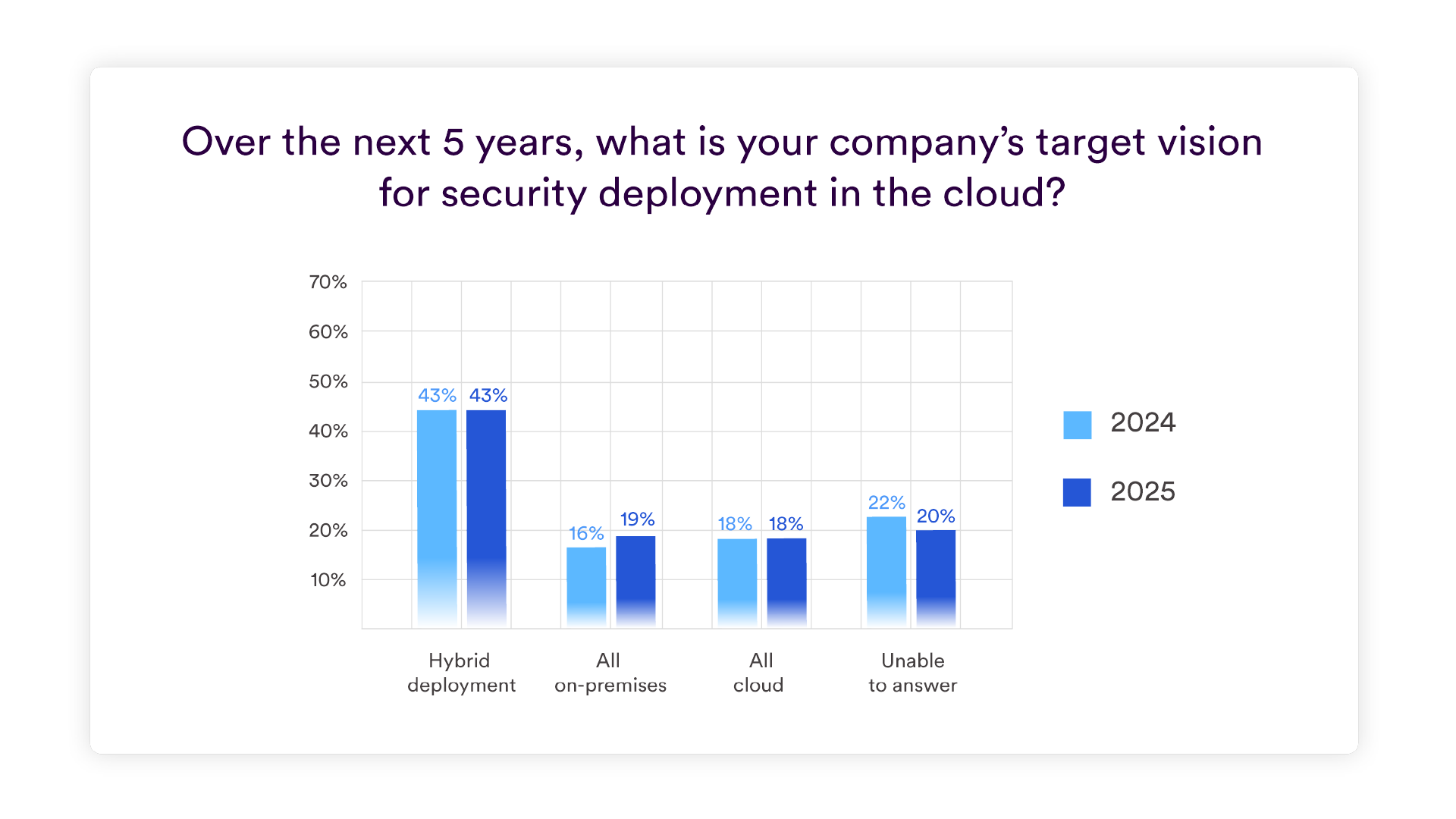
The takeaway? Flexibility matters, and the cloud is becoming the default path forward.
The flexibility of a hybrid deployment
Thinking about moving to the cloud, but not ready to transition to a full cloud deployment? A hybrid model is your best option. You can vary your deployment across sites, moving some system components to the cloud while keeping others on-premises.
All your system components can connect back to one centralized cloud-based platform. It doesn’t matter whether they’re deployed on-premises, at the edge, or in the cloud. This centralization lets your operators manage security across all your sites from a single interface. And the link to the cloud helps you maintain cybersecurity best practices across sites, too.
You can also swap out older proprietary NVRs for cloud-managed appliances. These appliances quickly connect existing devices to your cloud-based platform. This helps you keep some of your existing hardware while modernizing your deployment. Another benefit? Firmware and cybersecurity updates are automatically pushed to these devices from the cloud. This strengthens cybersecurity and eliminates the need to send technicians on-site for maintenance.
Ebook
Why choosing the right cloud solution matters
Keeping security systems safe from threats can be costly and complex. Usually, it requires dedicated resources, large budgets, and relentless diligence.
The right cloud solution is built with cybersecurity features and tools to help you automate processes and stay on top of threats. The right vendor will have a team of experts working proactively to ensure your systems are always hardened and secure. This lets you focus on what matters most—keeping everyday life and operations running smoothly.
