


Modern hospital security: Systems, challenges, and best practices
Learn what questions to ask about security solutions and which features can help improve hospital staff safety and the patient experience.

Hospitals don’t have “off hours.” The doors are open, the pace is constant, and security teams are responsible for keeping hundreds—or even thousands—of people safe at any given moment.
Hospital security teams face a unique challenge in keeping these environments secure. Yet many still rely on a patchwork of older systems.
To understand why change is needed, it helps to look at what makes healthcare environments so complex, why traditional approaches fall short, and what a more modern, unified approach can do differently.
EBOOK
Why hospital security is uniquely challenging
Healthcare security is fundamentally different from securing a corporate office or retail space. Unlike commercial facilities, hospitals remain open by default. Anyone can walk through the front door—and in most cases, they should be able to. That openness is essential to care delivery. It also makes security more complex. Here are some common issues specific to healthcare settings.
Workplace violence
Workplace violence in healthcare is one of the most pressing risks. According to the World Health Organization, up to 38% of hospital workers suffer physical violence at some point in their careers.
Workplace violence happens in healthcare settings for various reasons:
- Visitor management – Long wait times for guests create frustration that can quickly escalate
- High emotional intensity – Stress, grief, and fear are part of the hospital environment and can escalate quickly into violence
Staff don’t want to work in a place where they feel they’re at risk, making recruitment and retention difficult.
Operational complexities
Healthcare settings also have complex logistics that make it difficult to prevent and respond to incidents:
- 24/7 operations – Hospitals never close, which means there’s no “good time” to run audits or perform maintenance
- Multiple public entry points – Campuses have dozens of entrances across many buildings. Each one is a potential gap in visibility
- Perimeter blind spots – Parking garages and exterior walkways are part of the overall visitor experience, but are sometimes overlooked in planning
- Diverse occupants – Patients, visitors, staff, contractors, and vendors all need varying levels of access
- Unauthorized access – Access is often granted but rarely reviewed, leaving ex-employees, guests, and contractors with permissions they should no longer have
- Legacy systems – Most US health systems manage security across acquired facilities with disconnected hardware
Healthcare-specific requirements
Hospitals also face unique issues based on who they serve and what they provide:
- Privacy and compliance obligations – HIPAA and other regulatory frameworks create strict requirements around audits and privacy
- Supply and pharmaceutical theft – Without proper access controls and audit trails, loss in storage and delivery areas often goes undetected
BLOG
Each of these risks is serious on its own. Disconnected systems and manual workflows make it harder to respond quickly, and even harder to understand what actually happened after the fact.
For example, when access control isn’t linked to video surveillance, it’s time-consuming, or even impossible, to trace who accessed something they shouldn’t have, and where they went next.
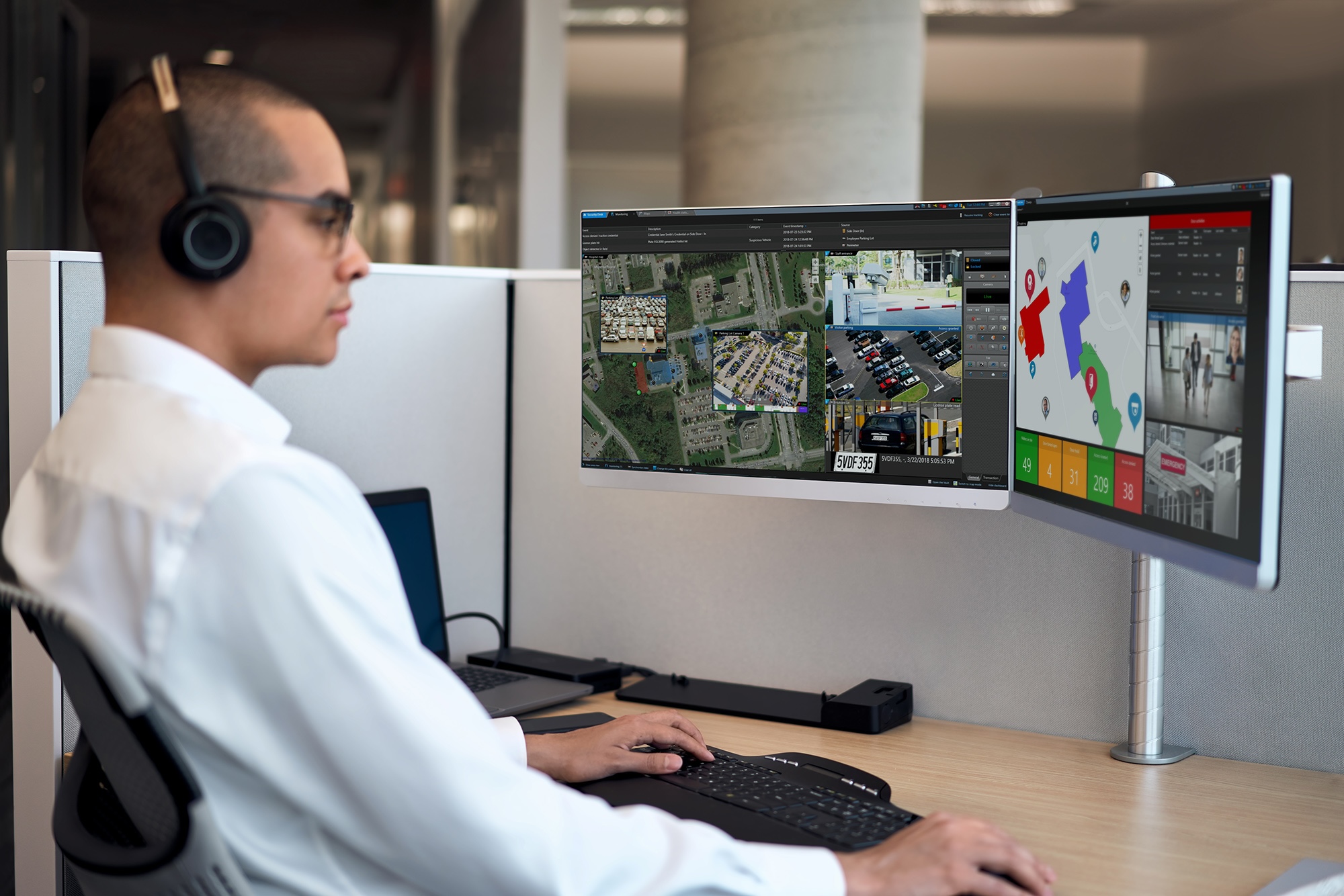
A modern solution brings security systems together in a single platform, so security teams can see what’s happening in a dynamic environment like a hospital.
Benefits of unified healthcare security solutions
Security system unification leads to actionable intelligence. Real-time inputs add context to unfolding incidents, so responses and investigations are faster and more coordinated. Instead of jumping between systems, teams get what they need in one place. And the value doesn’t stop at security. Other teams—from facilities to operations—can use the same data to improve staffing, maintenance, and planning decisions.
In a healthcare environment, compliance and liability also go hand in hand. Joint Commission, HIPAA requirements, and other industry regulations require accessible documentation across access, video, and incident records. Non-compliance carries serious financial consequences. A unified platform helps keep documentation organized and audit-ready.
Here’s a deep dive into some of the benefits of a unified platform.
✓ Visibility across campuses and facilities
A modern system brings video, access control, intercoms, and more into a single view, so teams can quickly understand what’s happening and act on it.
✓ Auditable access control for hospitals
With identity-based, zero-trust access control, people get access because they need it, not just because they’ve had it before. Users should be able to manage permissions by role, location, time, or risk level, while maintaining an auditable access log.
✓ Simpler visitor experience
Security systems can integrate with visitor management tools at the front desk. Healthcare teams can manage contractors and vendors the same way, limiting their access to authorized areas and times.
✓ Vehicle and perimeter awareness
Vehicle awareness helps security teams maintain visibility of what happens outside the building. Automatic license plate recognition (ALPR) tools automatically screen vehicles against watch lists and alert security officers to flagged individuals in real time, before they enter the building.
✓ Coordinated incident monitoring and response
During an incident response, security teams need to know where their officers are and the context surrounding the event. A unified platform makes this possible by providing real-time information and consolidating data and workflows into a single interface.
✓ Modernization without lock-in
Open architecture and flexible licensing mean security, IT, and facility teams can add new capabilities over time, avoiding vendor lock-in.
VIDEO
What to look for in a hospital security system
If you’re evaluating solutions, here are a few smart questions to ask:
- Can it scale as you grow? Look for a platform that lets you start with core capabilities and expand over time or scale as the hospital system adds new buildings and campuses.
- Is it easy to learn and use? Intuitive interfaces and automated workflows help you manage complexities and extend security functions to other team members, such as front desk receptionists and facilities.
- What happens to existing systems? Open architecture protects your investment and allows you to modernize incrementally, often using some existing infrastructure.
- What about cybersecurity? Ask vendors how they handle firmware updates, connected devices, and patch management. Cloud or hybrid deployment options can also help reduce the burden of ongoing maintenance requirements for the IT team.
- Does it deliver value beyond security? Operational data from your security system can often support business decisions. Measurable value makes technology investments easier to justify and builds a stronger case for future growth.
Making hospital security work in complex environments
Securing a hospital isn’t like securing any other environment. Complex operations and an emotionally charged setting require a security strategy built for healthcare.
A unified platform helps teams respond faster and operate more effectively. It protects patients, visitors, and staff without disrupting care and delivers value across operations, from staffing and safety to compliance and planning.
